 To main content
To navigation


Large collaboration with grid operators to relieve overloaded electricity network
In parts of the Netherlands, the electricity grid is becoming overloaded. As a result, some households already have to wait for a power connection. The grid congestion also causes delays in housing construction and home renovations. On the Radboud University campus in Nijmegen, research institute HFML-FELIX and grid operators TenneT and Liander have worked together to find a solution for the overloaded local electricity grid. The result is an exceptional collaboration that will create more room on the grid starting this November.
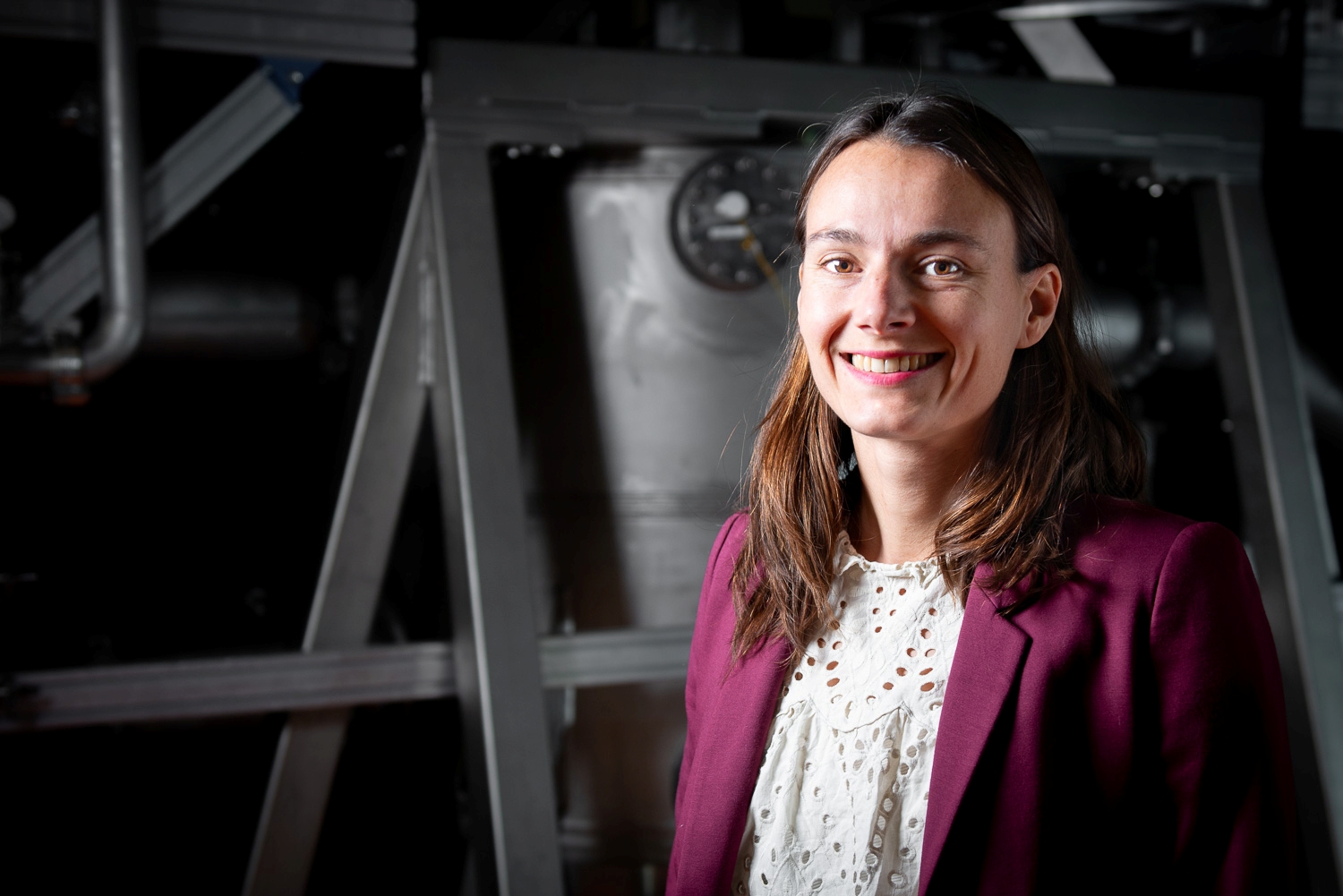
HFML-FELIX sustainability advisor Femke Bangma explains: “In our lab we have a large 50 kV connection, which we use for research with powerful magnets. For this connection we have a contracted transport capacity of 19.5 megawatts. To indicate how much that is, a comparison is often made with the number of households that consume the same amount power. In our case that is a bit tricky, because our electricity consumption varies greatly depending on the type of research we do with the magnets. Our average electricity consumption in 2025, for example, was around that of 1,600 households. But when we set the magnet to maximum strength, it uses as much electricity as more than 10,000 households.”
Adjusted shifts
That is exactly why it was interesting for the grid operators to talk to HFML-FELIX. If those peaks coincide with the times of day when households use the most electricity (between five and ten in the morning and evening), the local grid comes under heavy strain. Hence the question: can you change the timing of the experiments to when the grid isn’t already overloaded?
For HFML-FELIX there of course has to remain enough opportunity to carry out research. Because shifts are usually scheduled well in advance, it would not be possible, for example, to make an adjustment on the day itself. “But we can organize our shifts in a way that we are structurally outside the peak hours,” says Bangma. “For us, that means no more morning and evening shifts, but more shifts in the middle of the day and at night, and more shifts in the summer instead of the winter. This helps to relieve the local grid, but it has another benefit: as a result we also use more clean electricity, making the research itself more sustainable.”
Further sustainability efforts
The collaboration with grid operators fits well with the sustainability policy and the strategy of Radboud University as a whole. HFML-FELIX has already contributed to this by returning the heat released during experiments to the campus, so that buildings can be heated more sustainably. “And we are continually looking at improvements in the labs,” Bangma emphasizes. “Cooling our buffers more slowly, so that we return more heat. Or not running the high-pressure pumps that push water through the magnets at full power when that isn’t necessary. There are still a number of processes we want to tackle, but because we work with extremely strong magnets, this has to be done with great care.”
Research contact
Femke Bangma
More info about Femke

Other news
Unravelling the mystery of high-temperature superconductivity
Apply for research time before 15 November
Visit the lab during the Weekend of science!
A better understanding of the structure of steroid hormones
Two HFML-FELIX projects receive funding for modernizing research infrastructure
Sandra Brünken receives Special Review Lecturer Award
Finally, we know more about the elusive magnetic properties of small groups of atoms
Four new projects receive funding out of the HFML-FELIX Incentive Fund

Apply for research time before 15 May
Holland High Tech funding for detection and identification of chemical unknowns
Why researchers want to levitate living cells in high magnetic fields
‘When I finish an experiment, it is often not the end of something, but the beginning.’
HFML-FELIX at NWO Physics 2026: Exploring Matter Under Extreme Conditions
When electrons sing in harmony

Happy holidays from all of us!
HFML-FELIX researcher Olga Duda wins NWO Poster Award second year in a row
How a sunscreen molecule that encounters metal ions can absorb light in a very different way

Promising new technologies for researching inherited metabolic diseases

First four projects to receive funding out of the new Incentive Fund
Chemists find clues to the origins of iconic ‘football molecule’ in space