 To main content
To navigation
To main content
To navigation



Four new projects receive funding out of the HFML-FELIX Incentive Fund
As the newest NWO Institute, research infrastructure HFML-FELIX is now part of a large national consortium, consisting of several Dutch universities and Radboudumc. To kick start these exciting partnerships and to strengthen the scientific collaboration on a national level, HFML-FELIX has introduced its own Incentive Fund. After the first four partner projects were granted funding in November 2025, four more projects have now been awarded funding.
The accepted proposals cover a broad range of research topics and will create three new PhD positions and one postdoc position, as well as enable the development of new scientific instrumentation. The following projects have obtained funding within this second call of the Incentive Fund:
1. LTS-HTS Hybrid Solenoid Infrastructure Development.
Lead applicant J.M. van Oort (UT) together with M.M.J. Dhallé (UT), in collaboration with A. den Ouden (HFML-FELIX), F.J.P. Wijnen (HFML-FELIX) and T.J. Boelens (HFML-FELIX): ‘HFML‑FELIX is redefining its role as it became a national research institute, placing new emphasis on advanced magnet technology. The institute plans to start R&D on high‑temperature superconductor (HTS) coils for powerful next‑generation magnets that are more efficient and cheaper to operate. A large step forward is this collaboration with EMS at the University of Twente, a leading group in superconductivity. Within the project the focus will be on developing a machine dedicated for winding HTS coils, and subsequently testing them under different experimental conditions. This initiative will support cutting‑edge science and can act as a steppingstone towards larger collaborations.
2. On-demand magnetic stiffening 3D hydrogel networks for protoplast mechanobiology.
Lead applicants M. Kamperman (RUG), A. Mukherjee (RUG) and P. Christianen (HFML-FELIX), together with H. Engelkamp (HFML-FELIX), and P. Kouwer (RU): ‘By leveraging the high magnetic fields available at HFML-FELIX, we will develop mechanically adaptive hydrogel networks that can be stiffened on demand to control the microenvironment of plant cells in real time. These adaptive 3D materials mimic the dynamic conditions experienced during plant regeneration, a key but largely unexplored factor in plant biology. This approach will allow us, for the first time, to directly control and study how physical cues guide plant cell fate and regeneration.’
3. Lattice-Enabled Magnetism in fRUstrated systems (LEMUR).
Lead applicant M.E. Kamminga (UU) together with D. Afanasiev (RU) in collaboration with C. Davies (HMFL-FELIX): ‘While equilibrium theories can explain how exchange interactions stabilize ordered magnetic ground states, they fail to capture non-equilibrium kinetics of magnetic order. To tackle this, we will synthesize frustrated magnets, use neutron scattering to determine the magnetic ground state, and use femtosecond pulses and mid-/far-infrared excitations to drive the magnetism out of equilibrium. In doing so, we will determine the intrinsic response times while simultaneously capturing in real-time how magnetic correlations evolve into long range magnetic order.’
4. From Unknowns to Isomer-Resolved Structures: Next Generation IRIS-Based Biomarker Discovery at HFML-FELIX.
Lead applicant P. Kulkarni (RUMC) together with T. Boltje (RU), D.J. Lefeber (RUMC) and U.F.H. Engelke (RUMC) in collaboration with J. Oomens (HFML-FELIX) and J. Martens (HFML-FELIX): ‘In this project, we will implement a cutting-edge infrared ion spectroscopy workflow at HFML-FELIX by integrating a cryogenic ion trap. By cooling ions to extreme temperatures, this approach suppresses higher-energy conformers, reducing spectral congestion and enabling precise, isomer-resolved structure identification, particularly for complex biomolecules such as oligosaccharides and lipids. The implementation of this workflow will create a globally unique platform: LC-coupled cryogenic free-electron laser-based infrared ion spectroscopy. This development will not just foster collaborations with (national and international) metabolic centres for structure elucidation of potential biomarkers, but also with a broad range of analytical institutions seeking advanced structure elucidation capabilities.’
HFML-FELIX congratulates all four applicants and their teams with their funding. The projects are expected to start the end of this year.
Research contact
Andries den Ouden
More info about Andries
Dr. Jonathan Martens
More info about Jonathan
Dr. Frans Wijnen
More info about Frans
Prof. dr. Jos Oomens
More info about Jos
Prof. dr. Peter Christianen
More info about Peter
Tonke Boelens
More info about Tonke
Dr. Hans Engelkamp
More info about Hans
Dr. Carl Davies
More info about Carl
Other news
Visit the lab during the Weekend of science!

A better understanding of the structure of steroid hormones

Two HFML-FELIX projects receive funding for modernizing research infrastructure
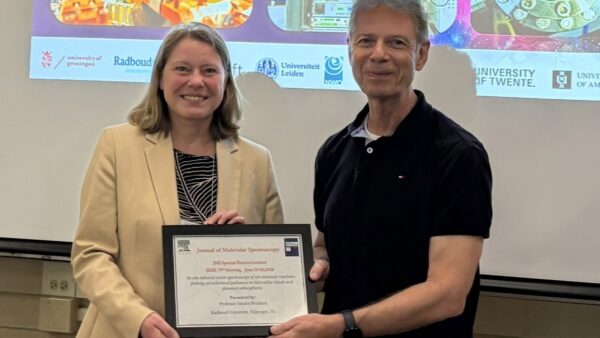
Sandra Brünken receives Special Review Lecturer Award
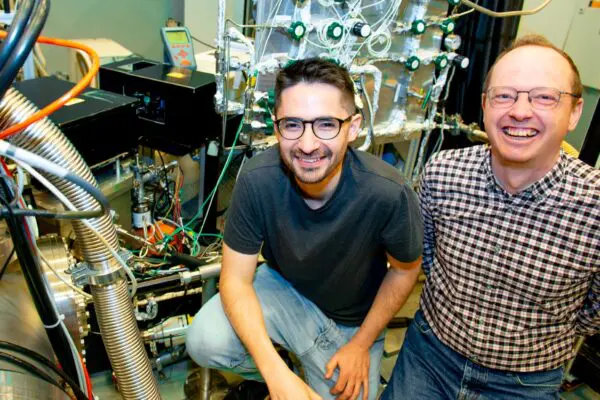
Finally, we know more about the elusive magnetic properties of small groups of atoms
Apply for research time before 15 May
Holland High Tech funding for detection and identification of chemical unknowns

Why researchers want to levitate living cells in high magnetic fields
‘When I finish an experiment, it is often not the end of something, but the beginning.’

HFML-FELIX at NWO Physics 2026: Exploring Matter Under Extreme Conditions

When electrons sing in harmony

Happy holidays from all of us!
HFML-FELIX researcher Olga Duda wins NWO Poster Award second year in a row
How a sunscreen molecule that encounters metal ions can absorb light in a very different way

Promising new technologies for researching inherited metabolic diseases

First four projects to receive funding out of the new Incentive Fund

Chemists find clues to the origins of iconic ‘football molecule’ in space

Apply for research time before 15 November
Radboudumc joins HFML-FELIX as an official partner to advance metabolic disease research
Exciting research position in newly granted European project!