 To main content
To navigation
To main content
To navigation


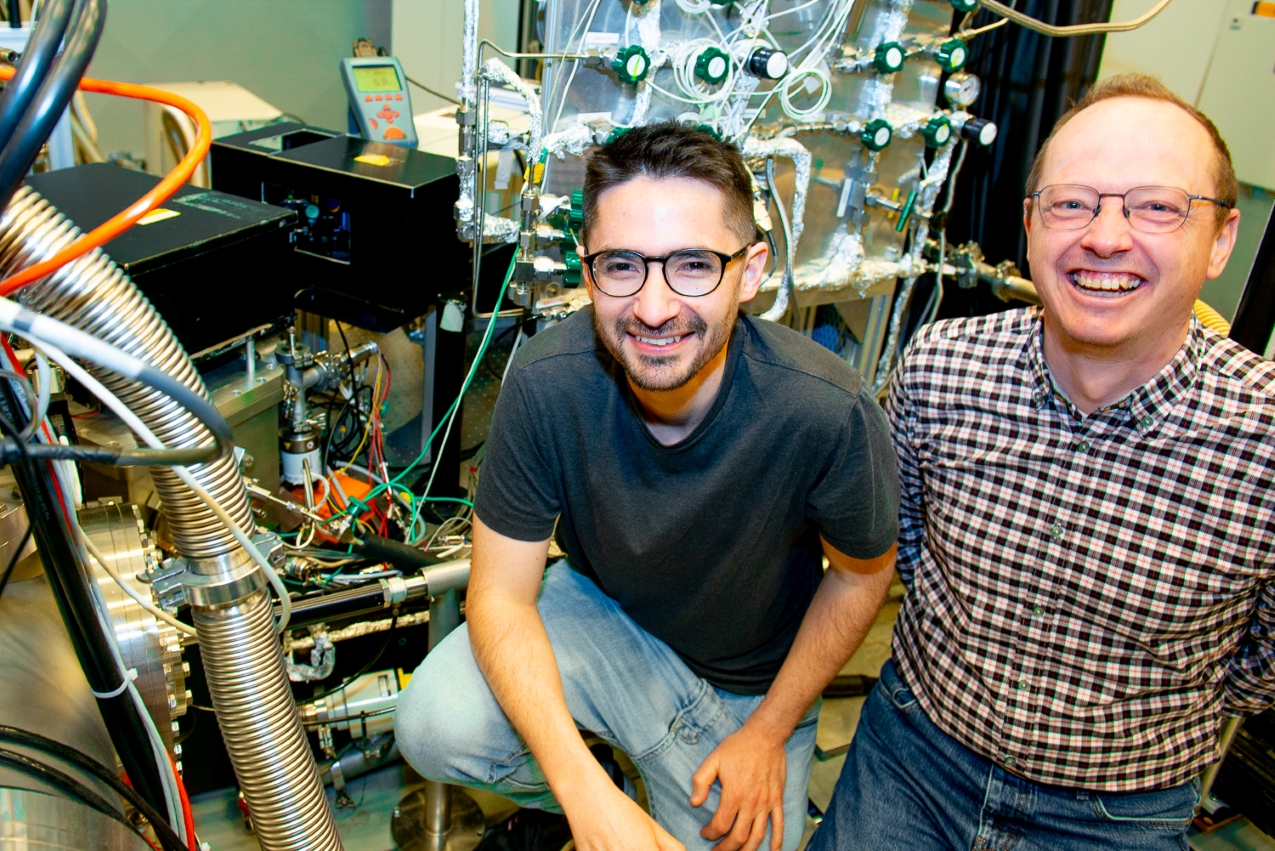
Finally, we know more about the elusive magnetic properties of small groups of atoms
When you have a solid material, say a piece of iron, that material has a specific set of properties that defines it. For instance: a certain conductivity, a heat capacity, or it can be magnetic or not. However, if you have a single atom from the same material, it can have its very own properties. Those can be very different from the properties the material has as a solid.
Now, you would think that, when you start putting those single atoms together, making bigger and bigger groups until they form a solid again, their properties should gradually change to the properties of the solid. So, the more atoms you add, the more the material’s behaviour starts looking like that of the solid. In a graph displaying that property you might expect a straight line, linking the one single atom to the solid. Research, however, has shown that this is not the case at all. ‘Especially for small numbers – numbers we can count – it looks nothing like a straight line’, HFML-FELIX researcher Piero Ferrari explains. ‘You might have 3 atoms and the line moves up, then you have 5 and it jumps down, 10 and it goes back up, etcetera, until at some point it smooths out towards what the bulk state is.’
A whole new dimension
Now think of a material you want to use or manipulate. Perhaps you want to make electronics that is only a few layers of atoms thick. Or you are looking for a new material that has new exciting properties. In both cases you need to understand how this material behaves and how you can predict its behaviour. ‘You would think that we can build devices with only a limited number of elements: the elements in the periodic table’, Ferrari adds. ‘But when you start playing with the number of atoms of that material, it is like you open up a new dimension in the periodic table. All of a sudden, you have a bunch of new options, and you might see some very interesting novel behaviour.’
And then it gets important to understand, atom by atom, how this behaviour changes and what the ‘formula’ behind it is. ‘We would like to know this for atoms and materials in general, but in this study we looked at one material: iron, which is a very abundant metal. Specifically, we investigated how the magnetic properties of iron evolve atom-by-atom from the single iron atom towards the bulk, through a size range we call the cluster regime, where we see a very interesting pattern.’
No easy answers
How the behaviour of these atoms changes and how you can predict this are very fundamental questions that nobody has been able to answer yet. The difficulty lies in how small the particles are. For example, a cluster composed of 10 atoms, with a size of only half a nanometre – which is roughly a hundred thousand times smaller than a human hair – is not easy to study. People have found ways to produce the clusters in the lab, but measuring, for instance, the magnetism of the particles in these clusters has proven to be extremely hard. ‘These tiny particles need a very sensitive approach. Results from experiments that succeeded in doing measurements on cluster magnetism have contradicted each other a lot. Other researchers have spent time developing computational methods to predict theoretically the magnetism of iron clusters, but in turn, such calculations also tend to disagree with experiments.’
Old technique, new results
At HFML-FELIX Ferrari and his colleagues now show, in a paper published in Physical Review Letters, that an old technique can produce very promising results that could reconcile experiments and computations for small iron clusters. ‘Here in the lab, one of the techniques we use is infrared spectroscopy. With that you look at the vibrations of the atoms in a cluster. Looking at these movements gives you a structural ‘fingerprint’ of the clusters. We now show that when you use this technique for iron clusters, we get such a sensitive probe of the structure, that even the subtle differences in magnetism are visible.’
How this works
So picture a cluster of five iron atoms. They can arrange into a cluster in different ways. For example, the atoms could arrange in a circle, all in a single line, or perhaps they form a closed 3-dimensional pack. When you have the spectrum (fingerprint) of that cluster measured in an experiment, you can compare it to calculated spectra for all these possible configurations. Each time you simulate: what would come out if it was a line, is that the spectrum we measure or not? Until you find a match. This has been done for decades, but not with a focus on magnetism. ‘If you take a cluster with different magnetic moments, very different vibrational movements come out of your calculations. These differences show up in the spectrum. You can then again look at possible configurations until you find a match. This way we can pinpoint precisely what the magnetism is in a cluster.’
Eventually this gives you a blue print of sorts. A prediction of behaviour for different cluster sizes of the same material. ‘We show this for clusters of between 3 and 12 iron atoms, but we are looking into larger systems and different materials too. We hope to eventually prove, by combining these experiments with our calculations, that this method works for all kinds of magnetic systems. This would provide researchers with a very exciting new method, one that can predict magnetic behaviour in different materials, atom by atom.’ And that is something that can pave the way for exciting new materials and novel electronics.
Want to read more? You can find the full paper here:
Research contact
Deepak Pradeep
More info about Deepak

Dr. Piero Ferrari
More info about Piero

Dr. Joost Bakker
More info about Joost

Other news
Visit the lab during the Weekend of science!

A better understanding of the structure of steroid hormones

Two HFML-FELIX projects receive funding for modernizing research infrastructure
Sandra Brünken receives Special Review Lecturer Award
Four new projects receive funding out of the HFML-FELIX Incentive Fund

Apply for research time before 15 May

Holland High Tech funding for detection and identification of chemical unknowns

Why researchers want to levitate living cells in high magnetic fields
‘When I finish an experiment, it is often not the end of something, but the beginning.’

HFML-FELIX at NWO Physics 2026: Exploring Matter Under Extreme Conditions

When electrons sing in harmony

Happy holidays from all of us!
HFML-FELIX researcher Olga Duda wins NWO Poster Award second year in a row
How a sunscreen molecule that encounters metal ions can absorb light in a very different way

Promising new technologies for researching inherited metabolic diseases

First four projects to receive funding out of the new Incentive Fund
Chemists find clues to the origins of iconic ‘football molecule’ in space

Apply for research time before 15 November

Radboudumc joins HFML-FELIX as an official partner to advance metabolic disease research
Exciting research position in newly granted European project!