 To main content
To navigation
To main content
To navigation


When electrons sing in harmony
Quantum coherence – the ability of particles to move in synchrony like overlapping waves – is usually limited to exotic states such as superconductivity, where electrons pair up and flow coherently. In ordinary metals, collisions of the particles quickly destroy such coherence. But there is one metal that behaves differently.
In the kagome metal CsV₃Sb₅, after sculpting tiny crystalline pillars just a few micrometers across and applying magnetic fields, Aharonov–BohmA quantum-mechanical phenomenon in which an electrically charged particle is affected by an electromagnetic potential, despite being confined to a region in which both the magnetic field and electric field are zero. -like oscillations in electrical resistance are observed. The oscillations occur at regular intervals determined by the magnetic flux quantum that threads between adjacent layers of the metal.
A shared underlying mechanism
This phenomenon effectively transforms the material into a nanoscale Aharonov–Bohm interferometer, stacked vertically along the crystal structure. As a result, it demonstrates that electrons interfere collectively, even remaining coherent much longer than would be predicted by single-particle physics.
Several features reveal the cooperative nature of this effect. As the magnetic field angle is rotated, the oscillations abruptly switch between discrete frequencies rather than evolve smoothly. Even more strikingly, the coherence persists over distances longer than the electrons’ mean free path, ruling out an explanation based on independent particles bouncing through the crystal. The size of the oscillations is also telling: their amplitude closely matches other anomalous electronic responses previously reported in CsV₃Sb₅, hinting at a shared underlying mechanism that establishes intrinsic coherence in this material.
New research directions
Together, these findings shed new light on the still-debated correlated orders in kagome metals and position CsV₃Sb₅ as a rare platform where long-range coherent charge transport emerges without superconductivity. More broadly, they suggest that collective electronic coherence may be far more versatile – and widespread – than previously thought, opening new directions for exploring correlated quantum matter beyond conventional paradigms.
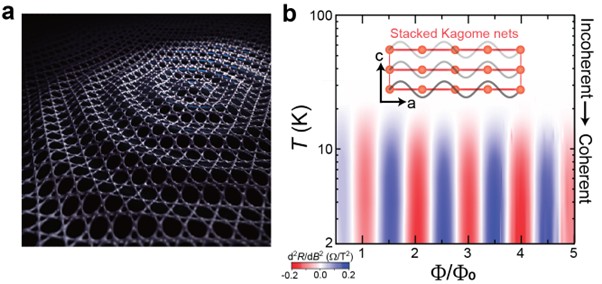
Figure: (a) illustration of long-range quantum coherence in a Kagome metal. (b) The temperature dependence of magnetoresistance oscillations demonstrates quantum-coherent transport at low temperatures.
You can find the full paper here: Many-body interference in kagome crystals
Principal investigators
Max Planck Institute for the Structure and Dynamics of Matter:
Chunyu Guo (Mark)
Philip J. W. Moll
Research contact at HFML-FELIX:
Other news
‘When I finish an experiment, it is often not the end of something, but the beginning.’

HFML-FELIX at NWO Physics 2026: Exploring Matter Under Extreme Conditions

Happy holidays from all of us!
HFML-FELIX researcher Olga Duda wins NWO Poster Award second year in a row

How a sunscreen molecule that encounters metal ions can absorb light in a very different way

Promising new technologies for researching inherited metabolic diseases

First four projects to receive funding out of the new Incentive Fund

Chemists find clues to the origins of iconic ‘football molecule’ in space

Apply for research time before 15 November

Radboudumc joins HFML-FELIX as an official partner to advance metabolic disease research
Exciting research position in newly granted European project!

Unraveling the secrets of space ice
Fingerprints of important interstellar molecules determined

Registration open for the ‘Astrochemistry: From Quantum to Cosmos’-meeting
A new, creative approach to switching magnetization
HFML-FELIX researchers win prize for molecules that stimulate crop growth
A successful 2025 HFML-FELIX User Meeting
Shedding light on a promising organic catalyst
Kim Steenbakkers awarded cum laude distinction at PhD defense
Breakthrough in metabolic disease research using infrared free-electron laser