 To main content
To navigation
To main content
To navigation


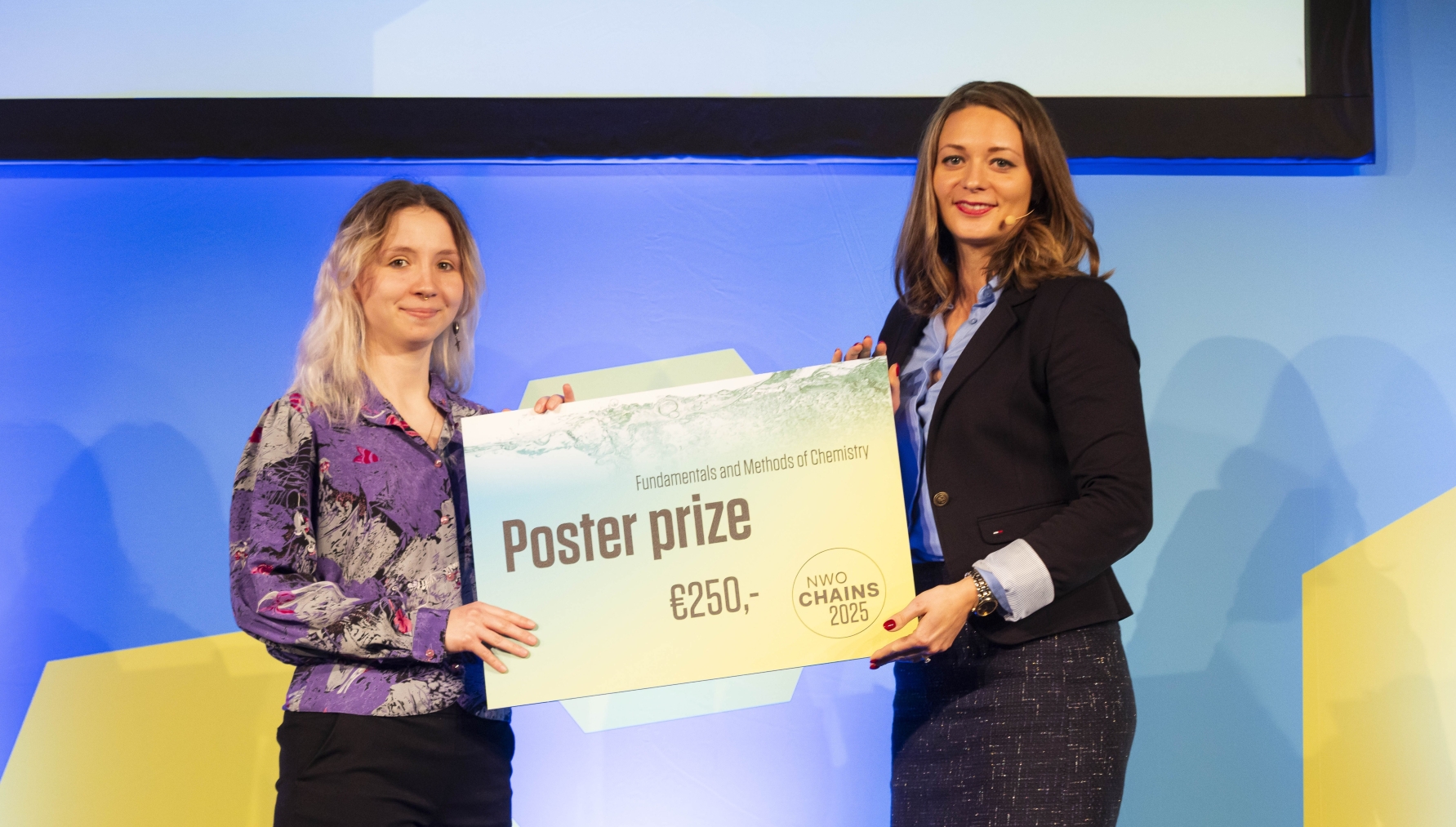
HFML-FELIX researcher Olga Duda wins NWO Poster Award second year in a row
Congratulations to our colleague Olga Duda for winning the NWO Poster Award at CHAINS, the annual Dutch chemistry conference for the second year in a row!
In her research, Duda uses infrared lasers to study the structure and properties of molecules. By hitting a molecule with an infrared laser beam, you deposit a lot of energy in it. That makes it react in very interesting ways. This can tell you something about the structure or function of the molecule, but what Duda is mostly interested in, is what happens to all that energy that goes into the molecule? Where exactly does it go?
Why do we want to know more about this? Exciting a molecule with infrared energy can be an interesting and very controlled way to induce a specific reaction in a chemical or biological process. The more detailed your knowledge of this reaction is, the more you are able to control such a process. And that is when it can get interesting for actual applications.
Every tiny vibration
So it is all about the details. Sending energy through a molecule makes it and its tiny parts move. Different wavelengths of infrared light cause different movements of different parts. The movements, or vibrations, that occur in reaction to the light, have many forms too. For instance: rotating, twisting or stretching. And one vibration can even react to or set in motion another vibration.
All these subtle changes need to be studied for every molecule you want to use. Once you have done that for simple molecules, you can start looking at more complicated ones, or even bigger systems of more than one molecule.
New insights
For now, Duda and co-workers have looked at a selection of molecules, among which is ammonia, a molecule relevant for research fields such as spectroscopy and astronomy. What they saw in their experiments is that exciting this molecule with the infrared laser allows them to observe the molecule in very high energy states different from those which can be accessed without infrared excitation. And yes, this molecule has been studied before using infrared light, but the unprecedented tunability of the laser at HFML-FELIX allowed for a greater control of how the molecule is excited. With that, the researchers were able to excite very specific rotations and vibrations.
Knowing the effect of all of these excitations of a molecule is interesting for a variety of applications. For example, exciting a specific vibration in a molecule can lead to a different outcome of a chemical reaction. It is a very controlled and economical way to influence a chemical process. More controlled and economical than, for instance, using heat or volume.
Looking at molecules in this way also tells researchers more about processes that occur in our bodies and in nature. Infrared light can induce certain molecular reactions in the lab which then can be studied in more detail. For instance: reactions which play an important role in protein folding or enzyme activity, something that is essential for most organisms to function.
Research contact
Olga Duda
More info about Olga

Other news
Visit the lab during the Weekend of science!

A better understanding of the structure of steroid hormones

Two HFML-FELIX projects receive funding for modernizing research infrastructure
Sandra Brünken receives Special Review Lecturer Award
Finally, we know more about the elusive magnetic properties of small groups of atoms
Four new projects receive funding out of the HFML-FELIX Incentive Fund

Apply for research time before 15 May

Holland High Tech funding for detection and identification of chemical unknowns

Why researchers want to levitate living cells in high magnetic fields
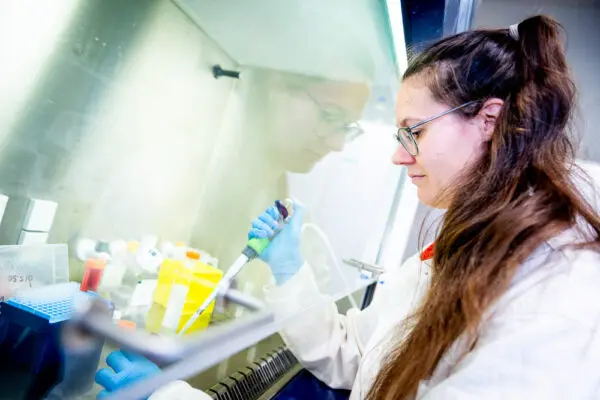
‘When I finish an experiment, it is often not the end of something, but the beginning.’

HFML-FELIX at NWO Physics 2026: Exploring Matter Under Extreme Conditions

When electrons sing in harmony

Happy holidays from all of us!
How a sunscreen molecule that encounters metal ions can absorb light in a very different way

Promising new technologies for researching inherited metabolic diseases

First four projects to receive funding out of the new Incentive Fund
Chemists find clues to the origins of iconic ‘football molecule’ in space

Apply for research time before 15 November

Radboudumc joins HFML-FELIX as an official partner to advance metabolic disease research
Exciting research position in newly granted European project!