 To main content
To navigation
To main content
To navigation



How a sunscreen molecule that encounters metal ions can absorb light in a very different way
Researchers of the group of Caroline Dessent at the University of York and HFML-FELIX have used a combination of laser spectroscopy and quantum chemistry to investigate how simple metal ions, such as those found in table salt, can affect the light-absorption properties of avobenzone.
Avobenzone is a common sunscreen molecule but is also a prototype “keto-enol” molecule. The keto-enol motif underpins much of synthetic organic chemistry and over recent years, light has been used to control this reactivity.
Published in the Journal of the American Chemical Society, the researchers found that metal ion binding reverses the stability of the keto and enol structures and hence dramatically changes the reactive events that follow light absorption in such systems. The work demonstrates how the electrostatic field exerted by a simple ion can change a molecule it binds to – this is important given how widespread keto-enol structures are in chemistry.
The results also have implications for the development and use of sunscreens, since Avobenzone is a widely used UVA filter molecule. Metal ion binding to Avobenzone, which can happen when a sunscreen formulation comes into contact with human skin or the sea, will reduce its photostability.
Post-doctoral researchers Sarah Wilson and Cate Anstöter jointly led the project, which was partly conducted in the group of Giel Berden and Jos Oomens at HFML-FELIX.
You can find the paper here: Disrupting the Photochemical Landscape of a β-Diketone via Electrostatic Perturbation of Ground-State Tautomers
Research contact
Prof. dr. Jos Oomens
More info about Jos

Dr. Giel Berden
More info about Giel

Other news
Visit the lab during the Weekend of science!

A better understanding of the structure of steroid hormones

Two HFML-FELIX projects receive funding for modernizing research infrastructure
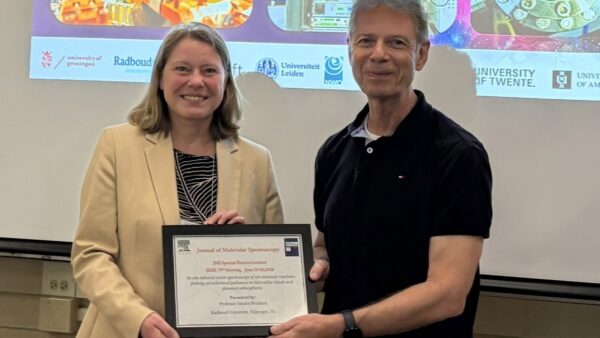
Sandra Brünken receives Special Review Lecturer Award
Finally, we know more about the elusive magnetic properties of small groups of atoms
Four new projects receive funding out of the HFML-FELIX Incentive Fund

Apply for research time before 15 May
Holland High Tech funding for detection and identification of chemical unknowns

Why researchers want to levitate living cells in high magnetic fields
‘When I finish an experiment, it is often not the end of something, but the beginning.’

HFML-FELIX at NWO Physics 2026: Exploring Matter Under Extreme Conditions

When electrons sing in harmony

Happy holidays from all of us!
HFML-FELIX researcher Olga Duda wins NWO Poster Award second year in a row
Promising new technologies for researching inherited metabolic diseases

First four projects to receive funding out of the new Incentive Fund
Chemists find clues to the origins of iconic ‘football molecule’ in space

Apply for research time before 15 November

Radboudumc joins HFML-FELIX as an official partner to advance metabolic disease research
Exciting research position in newly granted European project!