 To main content
To navigation
To main content
To navigation



First four projects to receive funding out of the new Incentive Fund
As the newest NWO Institute, research infrastructure HFML-FELIX is now part of a large national consortium, consisting of several Dutch universities and Radboudumc. To kick start these exciting partnerships and to strengthen the scientific collaboration on a national level, HFML-FELIX has introduced its own Incentive Fund. The first four partner projects have now been granted funding.
The accepted proposals cover a broad range of research topics and will create new PhD positions, as well as enable the development of new scientific instrumentation. The following projects have obtained funding within this first call of the new Incentive Fund:
1. Light on (photo)catalytic reaction mechanisms: catching reactive intermediates in the act.
Lead applicant W. J. Buma (UvA) together with P. Ferrari (HFML-FELIX), D. Galimberti (RU) and L. Visscher (VU). ‘In this project we will employ the unique capabilities of HFML-FELIX to investigate in detail catalytic reactive intermediates occurring along a catalytic cycle. By their very nature -they are short-lived and highly reactive- these intermediates are normally particularly difficult to get a grasp on. Recently, a novel approach based on molecular beams, infrared spectroscopy, and detailed quantum chemical calculations has been shown to be able to successfully tackle this challenge. As a result, the precise characteristics that give organocatalysts their distinct catalytic activity can now be elucidated, which paves the way for a rational design of new catalysts.’
2. Confocal imaging of magnetic dipolar colloids in ultrahigh magnetic fields.
Lead applicant R. Dullens (RU) together with A. van Blaaderen (UU), P. Christianen (HFML-FELIX) and H. Engelkamp (HFML-FELIX): ‘We propose to use ultrahigh magnetic fields to induce magnetic dipolar interactions in systems of non-magnetic colloids and study their self-assembly. We will focus on imaging the assembly dynamics in real-time and analyse the assembled structures at the particle level in 3D. The proposed research is groundbreaking as it represents the first experiments uncovering the 3D structure of dipolar magnetic colloids and will therefore open a host of opportunities for further work.’
3. Extreme-condition tuning of correlated physics in van der Waals heterostructures.
Lead applicant M. N. Ali (TU Delft) together with S. Bhattacharya (LU) and S. Wiedmann (HFML-FELIX): ‘This project will investigate how exotic quantum states of matter arise in ultra-thin, layered materials where the atoms are slightly twisted relative to one another. By combining extreme conditions, such as high magnetic fields and finely controlled pressure, these materials can be tuned in ways that were previously impossible. This will allow researchers from the TU Delft-Leiden- HFML-FELIX collaboration to directly test a key theoretical framework, the Zaanen-Sawatzky-Allen (ZSA) scheme, that explains why some materials behave as insulators, metals, or ‘something in between’. Beyond deepening our understanding of quantum matter, this work could open the door to designing materials with custom quantum properties, while also driving new experimental capabilities and strengthening long-term collaboration among leading Dutch research institutes.’
4. Beyond 3 Microns: FELIX-Enabled IR-MALDI for Advanced Mass Spectrometry Imaging.
Lead applicant R. M. Heeren (MU) together with I. Anthony (MU) and J. Martens (HFML-FELIX): ‘In this project we will create a new infrared mass-spectrometry-imaging platform that leverages the unique properties of the FELIX infrared laser to spatially resolve molecules in biological tissues. The source not only brings far greater sensitivity, but provides access to molecular systems that are beyond reach of conventional MS-based imaging systems. The ability to image labile oligosaccharides and oligonucleotides opens the door to new and more innovative glycobiological studies in biomedical research. This exemplifies how to national Large Scientific Research Infrastructures can synergize to accelerate biomedical research.’
HFML-FELIX congratulates all four applicants and their teams with their funding. The projects are set to start early next year.
Research contact
Dr. Jonathan Martens
More info about Jonathan
Prof. dr. Peter Christianen
More info about Peter

Dr. Piero Ferrari
More info about Piero
Dr. Hans Engelkamp
More info about Hans
Dr. Steffen Wiedmann
More info about Steffen

Other news
Visit the lab during the Weekend of science!

A better understanding of the structure of steroid hormones

Two HFML-FELIX projects receive funding for modernizing research infrastructure
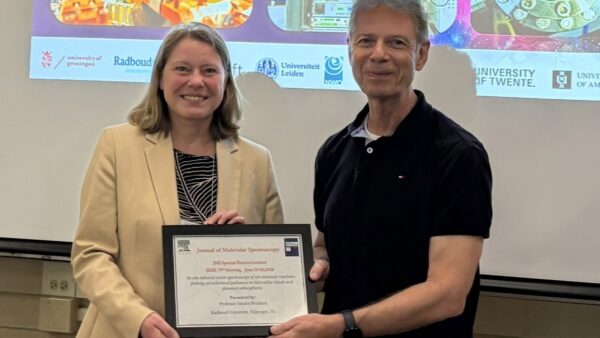
Sandra Brünken receives Special Review Lecturer Award
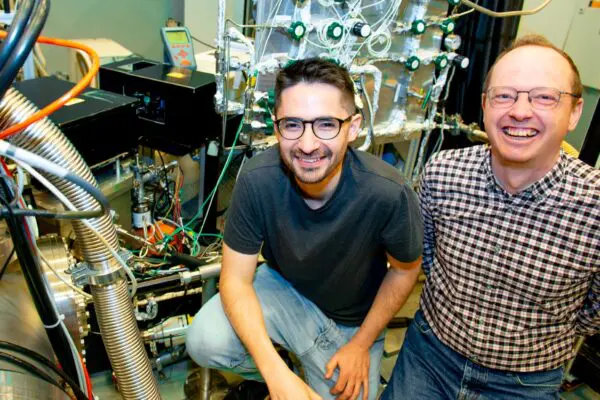
Finally, we know more about the elusive magnetic properties of small groups of atoms
Four new projects receive funding out of the HFML-FELIX Incentive Fund

Apply for research time before 15 May
Holland High Tech funding for detection and identification of chemical unknowns

Why researchers want to levitate living cells in high magnetic fields
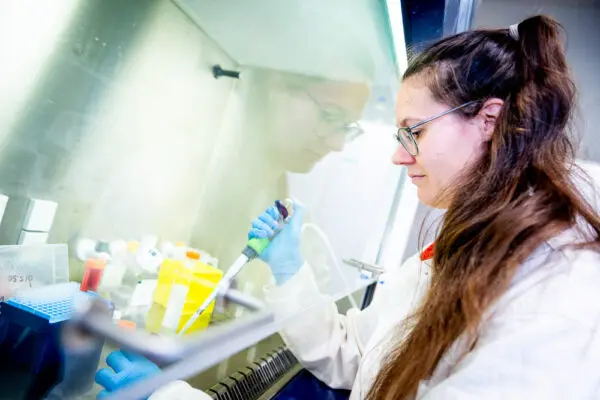
‘When I finish an experiment, it is often not the end of something, but the beginning.’

HFML-FELIX at NWO Physics 2026: Exploring Matter Under Extreme Conditions

When electrons sing in harmony

Happy holidays from all of us!
HFML-FELIX researcher Olga Duda wins NWO Poster Award second year in a row
How a sunscreen molecule that encounters metal ions can absorb light in a very different way

Promising new technologies for researching inherited metabolic diseases

Chemists find clues to the origins of iconic ‘football molecule’ in space

Apply for research time before 15 November
Radboudumc joins HFML-FELIX as an official partner to advance metabolic disease research
Exciting research position in newly granted European project!