 To main content
To navigation
To main content
To navigation


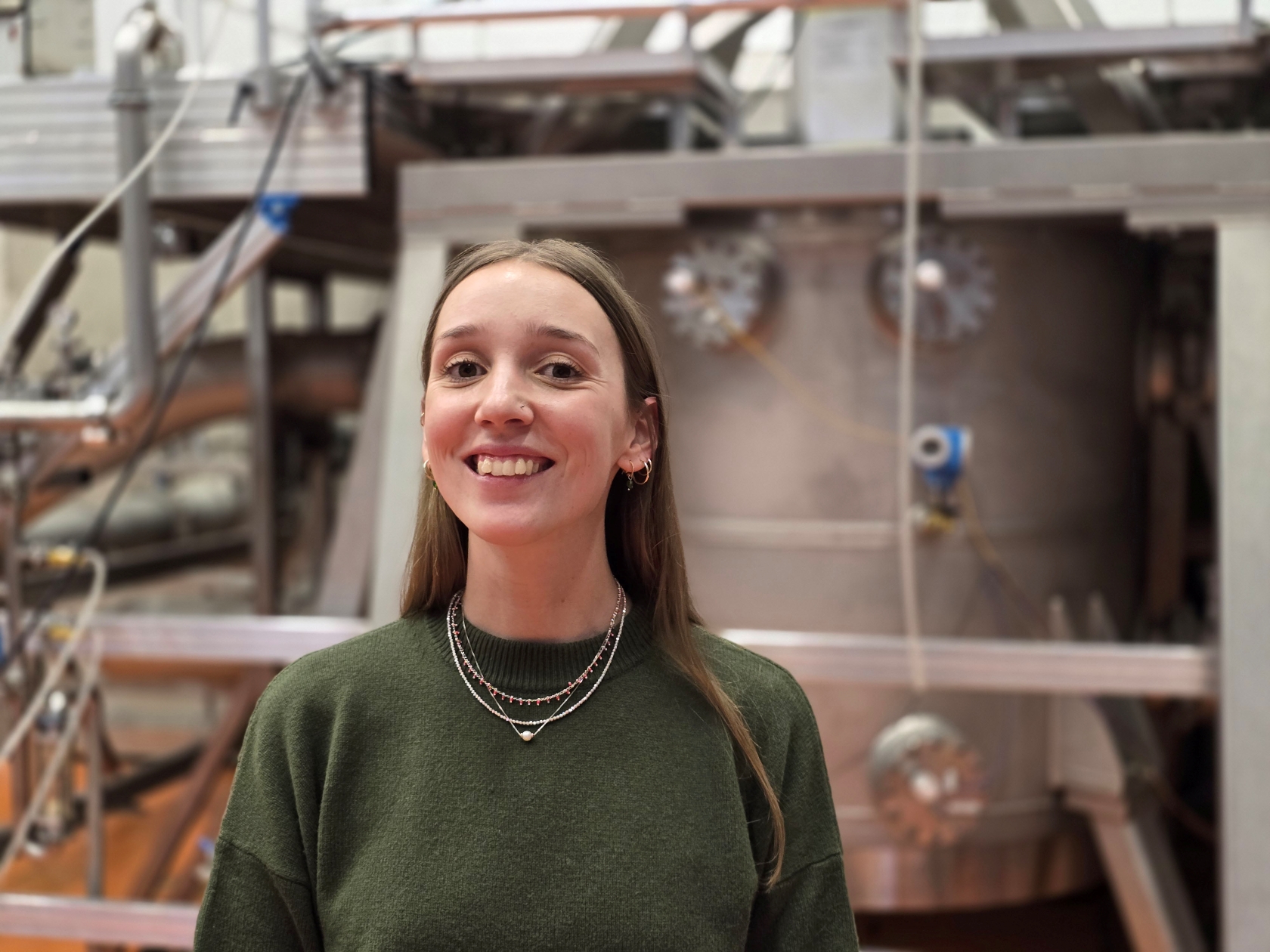
‘When I finish an experiment, it is often not the end of something, but the beginning.’
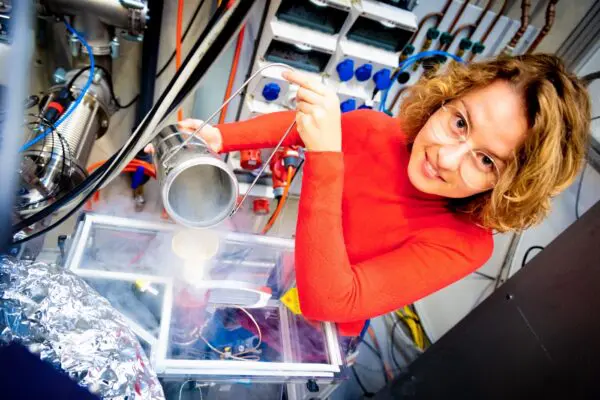
On the International day of women and girls in science, it is time to get to know the work of one of our own talented female colleagues a bit better. Chiara Cocchi is a PhD Candidate in the Correlated Electron Systems research group at HFML-FELIX. Now how did she end up working in a lab full of magnets?
‘When I arrived in Nijmegen for my second year of master’s I was looking to do an internship and ended up having a very nice conversation with one of the researchers here at HFML-FELIX. I also thought it would be really cool to work in a one of a kind facility with big magnets like they have here. I didn’t have a set goal from the beginning, but I did really like the idea of fundamental research with this very practical side to it.’
HFML-FELIX is a national research institute with unique facilities. Researchers from all over the world come here to study molecules and materials using some of the strongest magnets in the world and infrared free-electron lasers with an exceptional tuning range. These extreme forces enable scientist to study promising behavior and properties that you cannot see with other techniques. This provides knowledge that finds its way into medicine, new materials and more sustainable applications.
Room for creativity
Cocchi works on the magnet side of the institute. The instruments there allow her team to combine fundamental physics with very hands on experiments. ‘We try to make sense of different types of materials and study how they behave in a variety of circumstances. Our experiments of course start with a research question, based on previous work and designed to contribute to solving a bigger puzzle. But the beauty of looking deep into these fundamental mechanisms is: there can be a lot of surprises in the results. When you work on something that needs to be an application or product straight away, this is very different. We have a little more room to play. Very interesting and unexpected things can happen when you are not focused on what it needs to be in the end, but you are just looking into what you see happening right in front of you and what this means.’
Curious, but patient
For anyone wondering how you end up studying and working in physics: in Cocchi’s case it was a combination of coincidence and curiosity. ‘Originally I wanted to study medicine. When that didn’t work out, I ended up going for my second choice: physics. I have always loved figuring things out. And I was lucky to have a physics teacher, when I did a year of high school in Australia, who was very enthusiastic and creative in the way he taught us. We did all sorts of little experiments in class. He was very passionate and really made it come alive. It became a real thing, not just something in books. That played a big role in choosing my study direction in the end. I think being curious is something that you really need in this field. And patience too’, Cocchi says smiling. ‘Things do not always go the way you want. It can be very frustrating sometimes. Maybe the instrument set up does not work, and you have no clue why, or you don’t get usable results. But when you fix it and figure it out and an experiment you helped design actually works and the results are useful, it is so worth it.’
What she also noticed is that working in a lab like this, really helps bring together all of the theories you learn along the way. ‘In high school, or even at the beginning of college, a lot of things can seem so random. Not connected at all. Different mechanisms happening next to each other. But when you really dive deep into the subject and you work on it all of the time, you start connecting the dots and it kind of all comes together. So do not worry if you get lost a little at first, it will make sense later on and if it doesn’t it is probably even more interesting to figure out and you maybe just need to be a little more patient.’
The base of future applications
Now why would researchers spend their time looking at how material behaves? It is because there is a lot we do not know about molecules and materials and we are always looking for new things we can use. New molecules to help us understand or improve our health or environment, or new materials to make more sustainable and better electronical devises for instance.
When it comes to materials, especially when you take a tiny sample of something and you expose it to an extreme force like a strong magnetic field, they can show extraordinary and sometimes completely new properties. ‘The magnets we have here can reach a force of 38 tesla. That is a lot when you think of a kitchen magnet reaching only about 0,1. You can picture the magnets here as big barrels. Most of the inside of that barrel consists of the coil we need to create the magnetic field. In the middle of it, from top to bottom, there is a tube, with a diameter of a couple of centimeters. That is where the magnetic field is the strongest, and that is where you put your samples to study them. Ours are very small, around one millimeter in length.’
Once the sample is in there, the researchers can play with different parameters to see how it reacts. Moving it up and down to vary the strength of the magnetic field, for instance, changing the temperature or pressure, twisting it into different positions, adding atoms to the sample to see how they affect ts behavior or making it even thinner or smaller, to name a few options. And then you also need to detect what is happening to a sample on that very tiny scale. Which asks for a whole set of other instruments and computer programmes as well.
Promising properties
Cocchi studies two specific types of materials in this setting. ‘I look at topological materials, which are just a very broad class of materials which have specific quantum properties. That makes them good or promising for applications. And I also study correlated materials, for example iron-based superconductors, which are materials in which electrons behave different than they would in a normal material. They have bigger interactions between them, is a simple way of putting it. So they like to be with each other and react to each other. And then the idea is to see, okay, in materials where both these situations coexist, what properties come up? What is the interplay? And then maybe you see something like superconductivity arise and you can try to figure out where this effect comes from.’
One thing researchers have been trying to create or find are materials that show superconductivity at high temperatures. Having these materials would be interesting for quantum computers and other future applications. It is just one of the many examples of puzzles where fundamental research is necessary before you can actually start building something. ‘You need to really understand the base. What the exact structure is of a material, how it behaves, what makes it behave this way and how you can influence it with different techniques. That is what we try to figure out here. For me specifically in materials with unconventional superconductivity. And here we can see these processes in a very high resolution because of the strength of our magnets.’
Like she mentioned before, Cocchi does not mind that she is not working on a finished product. ‘I love being part of the road towards it. Adding to the knowledge that is necessary to get there. I don’t mind that when I finish an experiment it is not the end of something, but more the beginning. It is very exciting to create something that is not only interesting to me, but that is also something other scientists can build on.’
Research contact
Chiara Cocchi
More info about Chiara
Other news
Why researchers want to levitate living cells in high magnetic fields
HFML-FELIX at NWO Physics 2026: Exploring Matter Under Extreme Conditions

When electrons sing in harmony

Happy holidays from all of us!
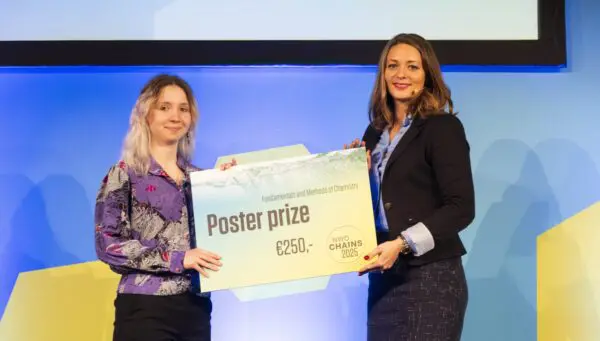
HFML-FELIX researcher Olga Duda wins NWO Poster Award second year in a row
How a sunscreen molecule that encounters metal ions can absorb light in a very different way

Promising new technologies for researching inherited metabolic diseases

First four projects to receive funding out of the new Incentive Fund

Chemists find clues to the origins of iconic ‘football molecule’ in space

Apply for research time before 15 November
Radboudumc joins HFML-FELIX as an official partner to advance metabolic disease research
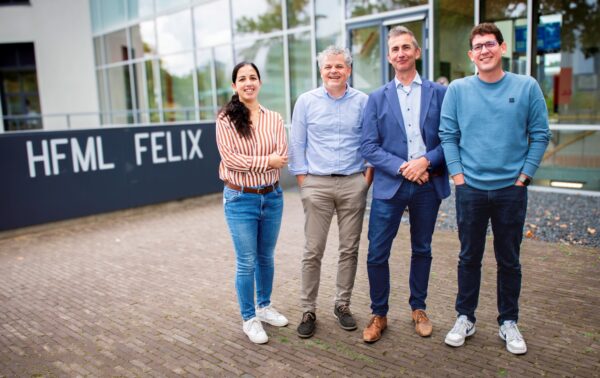
Exciting research position in newly granted European project!
Unraveling the secrets of space ice
Fingerprints of important interstellar molecules determined
Registration open for the ‘Astrochemistry: From Quantum to Cosmos’-meeting
A new, creative approach to switching magnetization
HFML-FELIX researchers win prize for molecules that stimulate crop growth
A successful 2025 HFML-FELIX User Meeting
Shedding light on a promising organic catalyst
Kim Steenbakkers awarded cum laude distinction at PhD defense